AEO – Answer Engine Optimization
Ad costs are rising while conversion rates fall, and the buyer journey increasingly starts in AI tools. Businesses should therefore complement paid advertising with AI visibility: clear product pages, comparison content, FAQs, and structured data that make your offer easy for AI systems to understand and recommend.
Many companies are now facing the same challenge: the cost of acquiring new customers is rising, while efficiency is declining. Triple Whale reported that the median conversion rate from paid ads in e-commerce was 2.01% in 2025, down 6.21% from the previous year, while the cost per acquisition increased by 8.64%.
Northbeam observed the same trend in its DTC dataset: ad spend increased by about 15%, revenue rose by about 14%, but marketing efficiency declined and the cost of acquiring new customers rose by nearly 9%. This isn’t just an advertising problem. It’s a problem of visibility, trust, and conversion.
What is AI visibility?
AI visibility refers to how easy it is to understand, trust, and recommend a company, product, or service in AI-driven responses. Unlike traditional SEO, where the goal is to rank in a list of results, AI visibility is about becoming part of the actual answer the user receives.
This means that businesses must do more than just optimize for clicks. They must also ensure that their content, product data, reviews, and positioning are clear enough for AI systems to use them as a basis when someone asks for recommendations, alternatives, or differences. You can read more about what AI visibility is in the article here.
Why is advertising getting more expensive?
Paid advertising has become less predictable because more brands are competing in the same auctions, privacy changes have weakened targeting signals, and customers are spending more time researching before they buy. As clicks become more expensive and fewer visitors convert, CAC rises rapidly even if traffic remains steady.
The old growth model was simple: buy traffic on Meta and Google, send users to a product page, retarget visitors, and improve ROAS over time. That model still works, but it’s less effective than before because distribution, measurement, and the decision-making process have all become more fragmented.
How is AI changing the customer journey?
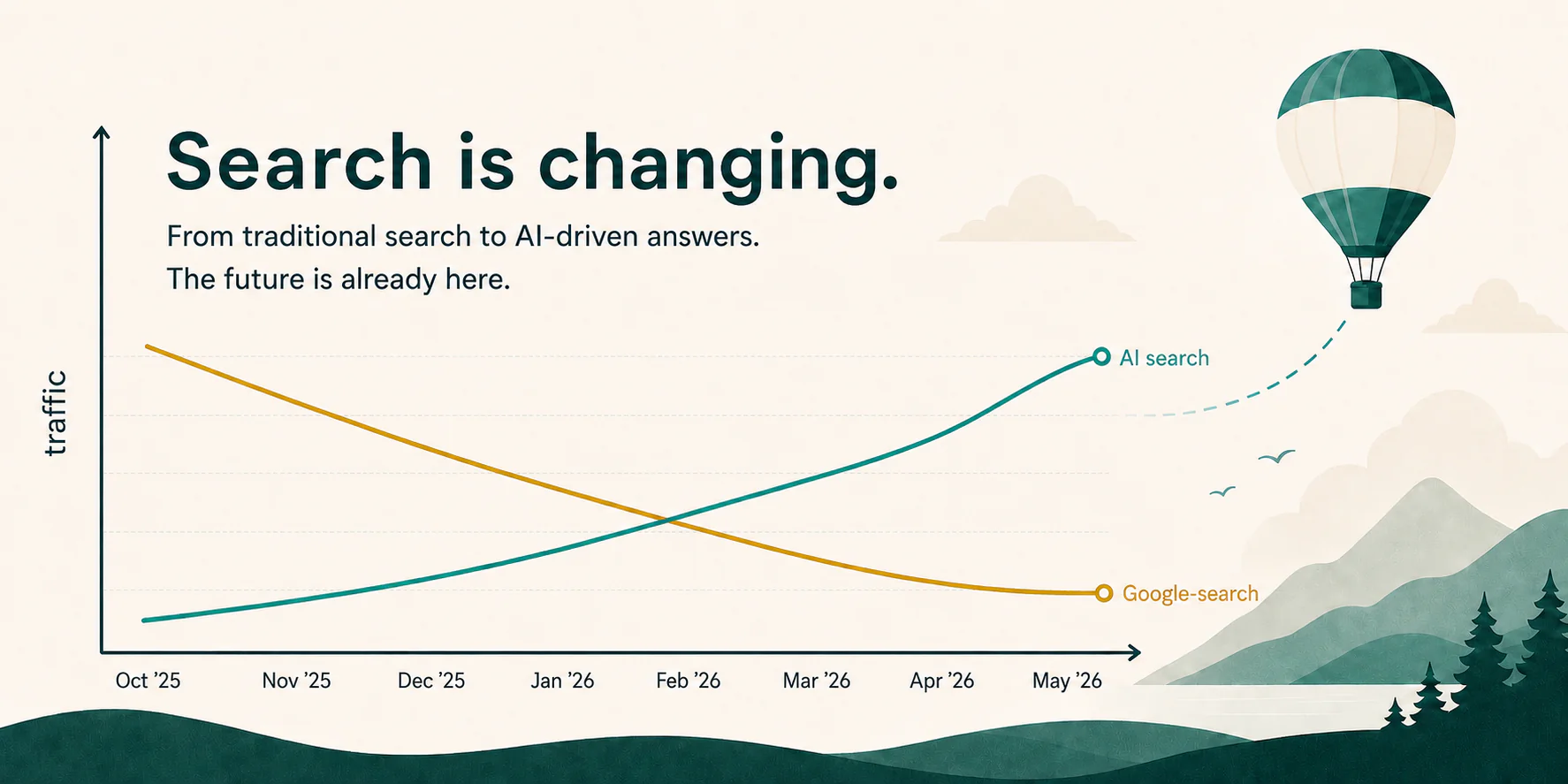
The customer journey is increasingly beginning with AI interfaces rather than traditional search results or social media platforms. Salesforce reports that 39% of consumers already use AI for product discovery, and that more than half of Gen Z does the same.
Tools such as ChatGPT, Perplexity, Gemini, and Google AI Overviews are now being used to research products, compare options, and shape purchase intent before a potential click occurs. Advertising Weekdescribes this as a growing “zero-click” reality, where users learn about a brand through AI but complete the purchase later via Google, Amazon, or direct traffic. Google itself also describes AI Overviews and AI Mode as new platforms for brand discovery and commercial searches.
What should companies do now?
Companies should first make their product and service pages more precise and AI-readable. A good page explains who the solution is intended for, what problem it solves, what sets it apart from alternatives, and what questions customers typically have before making a purchase.
Content should then be built around purchasing decisions, not just keywords. Articles, comparison pages, FAQs, and guides that answer questions such as “what’s best for,” “how to choose,” and “the difference between” provide AI systems with a better foundation for understanding and citing the content.
Reviews should also be treated as visibility signals, not just proof of conversion. When customers describe usage scenarios, effects, and context in natural language, it becomes easier for AI systems to link the product to specific needs and recommendation scenarios.
Ultimately, companies should improve the conversion foundation on their own websites before increasing their advertising budget. Faster loading times, a clearer value proposition, visible reviews, easy returns, and a frictionless checkout process can be just as effective as better campaign optimization.
How do you measure the impact?
When the influence occurs before the click, traditional attribution becomes less accurate. A customer might first receive a recommendation in ChatGPT or Perplexity, then search for the brand on Google, and finally make a purchase via direct traffic or a marketplace, while the analysis credits only the last touchpoint.
Therefore, companies should supplement traditional web analytics with post-purchase or post-lead surveys, track trends in branded search and direct traffic, and monitor how customers mention the brand in reviews, forms, and support inquiries. Advertising Week points out that the easiest way to understand the impact of AI is often to ask customers directly.
Why is AI visibility the next growth driver?
AI visibility does not replace SEO, CRO, or paid advertising. It brings them closer together by making product information, structure, reviews, and content easier to understand for both humans and machines.
The companies that will succeed in the future aren’t necessarily the ones that spend the most on advertising. They are the ones that make their offerings easy to understand, easy to trust, and easy to choose when AI systems help users make a decision.
How we approach this at Sikte AI
We have developed the Sikte method to provide a comprehensive AI visibility solution for companies that want to be understood, mentioned, and chosen in AI searches. We help companies assess their current standing, optimize their websites for AI visibility, and further refine their strategies to be recommended in AI searches. Learn more under Services.
Frequently asked questions
What is AI visibility?
AI visibility means your business is understood, mentioned, and chosen in answers from AI tools like ChatGPT, Perplexity, and Google AI. It is less about ranking in a list of links and more about becoming part of the answer the user receives.
Why is SEO alone no longer enough?
SEO is still important, but AI-driven discovery relies more heavily on clear product information, context, reviews, and content that helps the user make a decision. Salesforce describes this as a shift from keyword thinking to solution thinking.
How does AI affect the buyer journey?
AI often influences the early stage of the buyer journey, when users are exploring options and forming preferences. This means your brand can shape decisions before any measurable click happens.
What should an ecommerce business prioritize first?
Start with product pages, reviews, comparison content, and clearly structured information. The goal is to reduce ambiguity and make it easy for AI systems to understand what you sell, who it is for, and why it should be recommended.
How can Sikte AI help with AI visibility?
We have developed the Sikte method to deliver a complete AI visibility service for companies that want to be understood, mentioned, and chosen in AI search. Read more about our services.
Related articles:

Marianne Aas Lunde
Founder / AEO Specialist
Marianne leads Sikte's AEO work and helps companies get understood, cited, and recommended when buyers turn to AI assistants first.